Thermal Break Aluminum Windows and Doors: What They Are and When to Choose Them
Aluminum has earned its place as the go-to material for modern windows and doors — slim, strong, and endlessly adaptable. What turns a good aluminum frame into a high-performance one is the thermal break: the insulation system built into the frame itself that delivers real thermal and acoustic performance.
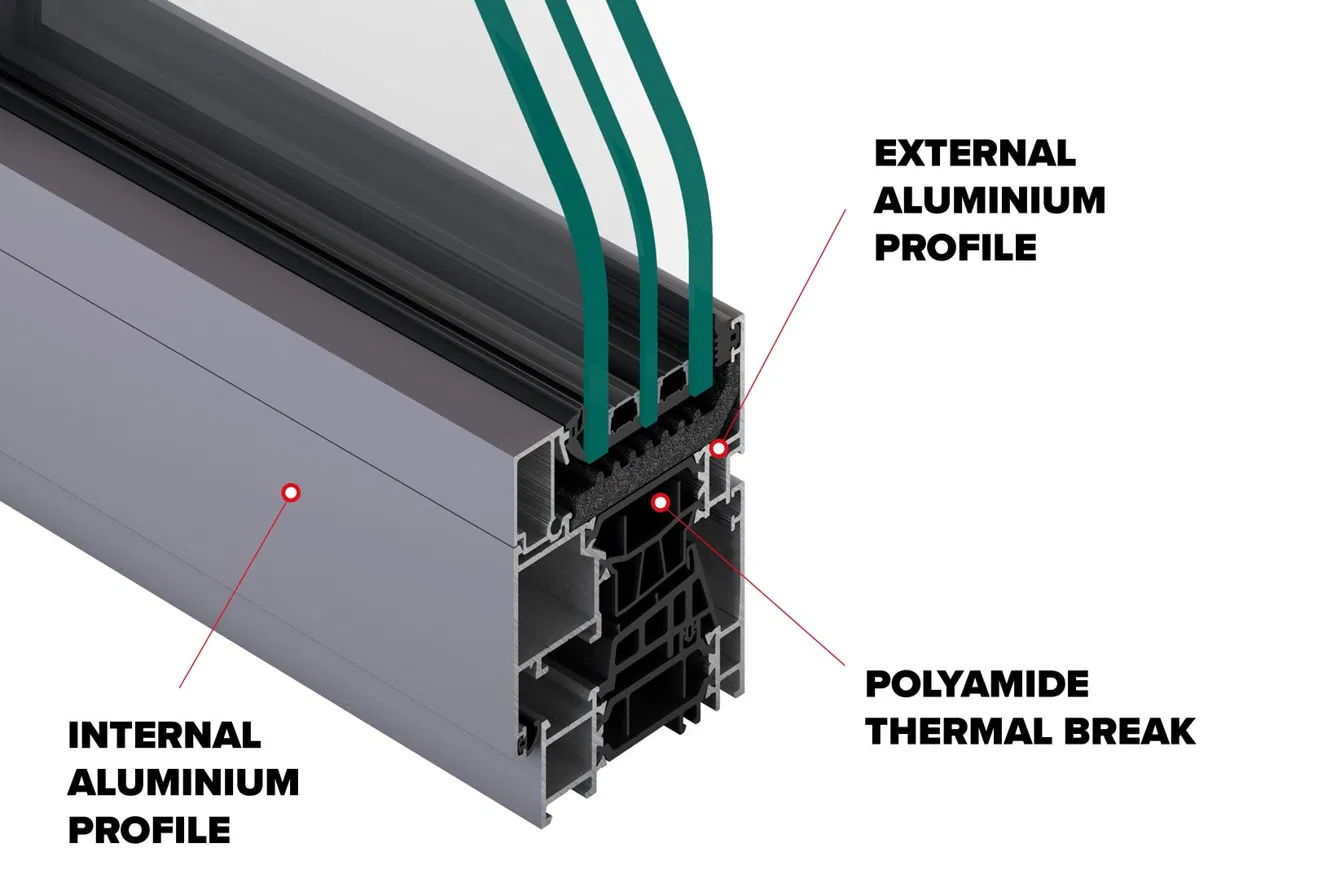
The thermal break: an insulating polyamide barrier separating the interior and exterior aluminum profiles.
The advantages of aluminum frames

Aluminum solves several problems at once. It is light to handle yet structurally strong, and it shrugs off weather that ages other frame materials — no warping in humidity, no rot, no seasonal swelling, which is why aluminum frames routinely outlast wood and vinyl with almost no maintenance.
Its strength is also what makes it beautiful. Because the material carries load so well, the profiles can stay remarkably thin — thinner than PVC or wood could ever safely be — which means narrower sightlines, more glass, and brighter rooms. The same strength is what lets a frame hold the large glass panels our sliding and folding walls are built around.
Finishes are equally flexible: powder-coated colors and styles that sit comfortably on anything from a contemporary build to a brick traditional, residential or commercial. And at the end of a very long service life, aluminum is fully recyclable.
The one thing bare aluminum does not naturally excel at is insulation — metal conducts heat. Modern frames solve that completely with the thermal break, which is what makes aluminum the complete package.

What thermal break aluminum frames are
Beyond letting light in and looking good, a window or door has one big functional job: insulation. A well-insulated opening keeps the indoor climate stable in every season, prevents condensation, and closes off the thermal bridges that leak conditioned air. That shows up directly on the energy bill, in both heating and cooling season.
Aluminum on its own conducts heat well — that is simply what metals do. The industry solved this decades ago with the thermal break: an insulating barrier integrated into the frame that interrupts — literally “breaks” — the path heat would travel between the outside face and the inside face of the frame. With the break in place, the conductivity of the metal is neutralized, and you get every advantage of aluminum without giving up insulation or comfort.
How the thermal break works
Inside a thermally broken frame, the exterior profile and the interior profile never touch. Between them sits a channel of glass-fiber-reinforced polyamide — a material chosen because it insulates extremely well, stays strong for decades, and expands and contracts at nearly the same rate as aluminum, so the assembly stays tight through temperature swings.
With no metal-to-metal contact, heat conduction through the frame drops to a minimum. That works in both directions and both climates: in a Houston summer the heat stays outside and the cooled air stays in; in winter, the reverse.
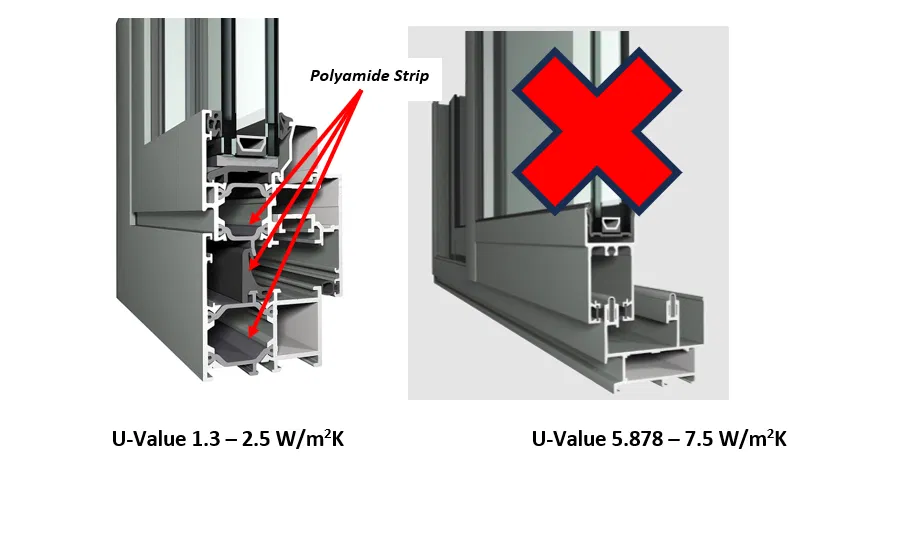
The difference is not subtle. Typical thermally broken aluminum frames test in the range of roughly 1.3–2.5 W/m²K, while non-broken aluminum frames run around 5.8–7.5 — several times more heat passing straight through the metal.
Thermal break also improves sound insulation
The same polyamide joint that stops heat also interrupts sound. A continuous metal frame transmits vibration efficiently; the thermal break decouples the two profiles, so less street noise makes it through the frame. Pair a thermally broken frame with insulated glazing and the whole opening gets noticeably quieter.
When to choose thermal break windows and doors
If you are conditioning your home for a Texas summer, glazing a large opening, or replacing frames where condensation keeps forming, thermally broken frames are the right call — the bigger the glass and the harder the climate works against you, the more the break earns back. Every aluminum door and window system we supply is built on thermally broken frames, from a single entry door to a full glass wall.
Related reading: What Is Thermal Break Aluminum? · Door Opening Directions, Explained (With Diagrams)
Planning a thermally broken opening?
Configure a size, compare systems, or send us your opening — we'll spec it with you.